

The Changing Face of Retail: Trend Forecasts for 2026
Topics we'll be covering in this article:
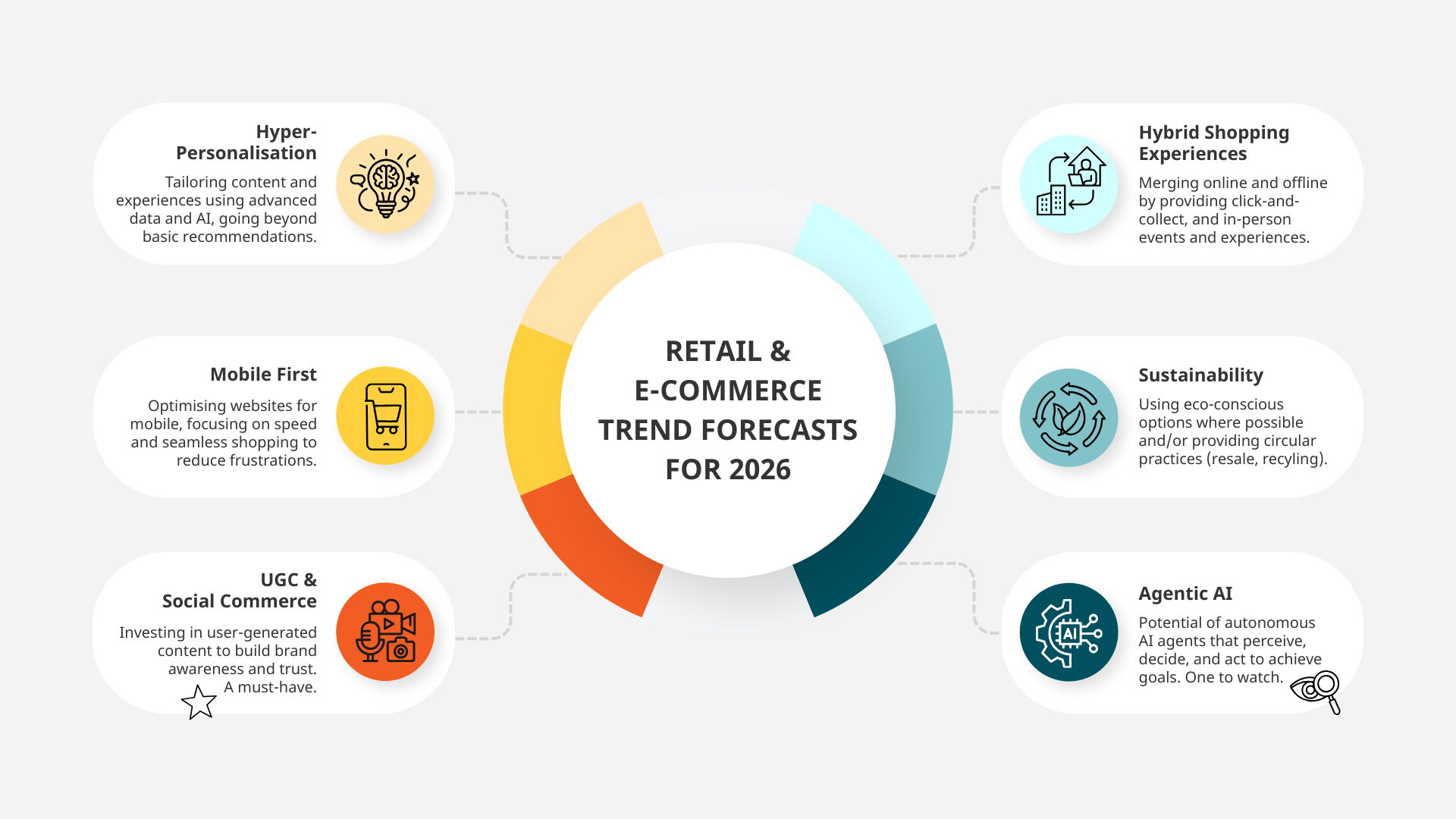
- Hyper-personalisation: Consumers know what they want and they expect retailers to know too, by offering hyper-personalised content and offers.
- Mobile First: The majority of online shopping has shifted from desktop to mobile, so websites must be optimised for mobile, or face visitors leaving.
- Social Commerce & UGC: Social media is the go-to for product research and discovery, and user-generated content (UGC) builds greater trust and is responded to more positively.
- Hybrid Shopping Experiences: Consumers use both digital and physical stores, with physical shops allowing for in-person product research, community events and the convenience of click-and-collect.
- Sustainability: Consumers still value sustainable practices where possible through recyclable or environmentally friendly packaging, or circular models such as repair services or resale platforms.
- Agentic AI: The next step for AI could be ‘Agentic AI,’ which some say would be able to tackle more complex processes and optimise workflows.
With 2025 now behind us, attention has shifted to 2026 and the trends poised to influence retail and e-commerce. Many of these topics will feel familiar, but evolving technology and changing economic conditions have given them new momentum, keeping them firmly in focus.
So, what exactly should businesses be keeping an eye on this year, and what makes these trends impossible to ignore?
Hyper-personalisation
With increased awareness of AI, retailers have been exploring different ways of integrating AI to enhance the shopping experience for consumers. ASOS, for example, has AI that can be used as a virtual personal shopper, providing recommendations based on individual preferences, alongside fit assistant tools that help minimise size-related returns and exchanges, and an AI-powered stylist to enhance product discovery (1).
While early uses of AI in this space were possibly viewed as more of a novelty, the growing desire for hyper-personalised experiences is making AI a more standard practice. Consumers are seeking more relevant offers and product recommendations tailored to them as individuals, rather than generic suggestions shared across broad demographic groups.
Learn more - The Power of Personalisation: Creating Tailored Customer Experiences in Retail - Part 1
Mobile-First
Unsurprisingly, more people are shopping on mobile, with over 70% of users expected to visit websites via their smartphones in 2026 (2). Combined with the growth of social commerce (a topic we’ll explore in the next section) and the increasing amount of time spent online, it’s reasonable that consumers expect a seamless, consistent experience across all devices. When a website isn’t optimised for mobile, users are much more likely to leave without any meaningful interaction.
This is closely tied to page performance. The bounce rate – the ratio or percentage of users who leave after viewing just one page, without clicking through to other pages – increases dramatically with each second that a website spends loading. Specifically, 53% of mobile visits are abandoned if a page takes longer than 3 seconds to load (3).
So, websites have a limited window to capture and hold a user’s attention. This helps explain the rapid rise of short-form content and why businesses shouldn’t neglect mobile-friendly practices, which leads us onto the next trend.
Social Commerce & UGC
In the UK, there are 54.8 million social media identities and 67.8 million internet users, meaning around 80% of people online are active on social platforms (4).
Businesses are clearly recognising this opportunity and investing, with influencer marketing spend reaching £930m, representing a year-on-year rise of 13.6% (£111m) (4). User-generated content (UGC) plays a major role in building a brand's visibility, with creators creating and sharing unboxing videos, reviews and more. Social media has now become the place where people research products, ideas and inspiration.
For example, ‘BookTok,’ the subcommunity for books and literature on TikTok, is so popular that you may have seen retailers like Waterstones and TGJones (formerly WHSmith) have dedicated ‘BookTok’ sections online and in-store.
Nearly half (48.6%) of adult internet users use social media to find information about brands and products (4), while an overwhelming 97% of Gen Z turn to these platforms for shopping inspiration (5). Consumers also respond more positively to ads with UGC, with businesses reporting a 73% increase in positive feedback when using UGC-led ads (5).
Social platforms themselves are increasingly bridging the gap between discovery and purchase, with TikTok creating TikTok Shop, and others, such as Facebook and even YouTube, following suit with their own in-app shopping experiences. And it’s worth it, with 56% directly purchasing through a social or entertainment platform, and for digital natives under 45, this figure rises to 73% (6).
Hybrid Shopping Experiences
With so much talk and focus surrounding social media and AI, it would be easy to assume that physical retail is becoming less relevant. But that’s not the case.
Hybrid shopping is not a new concept in retail, yet it will remain important for consumers in 2026. Research from Akeneo found that 75% of shoppers made an in-store purchase after researching online, while 65% did the opposite and bought online after researching in a physical store (7).
Brands are also investing more in in-store experiences, putting on events and creating spaces; something that can’t be replicated online. For example, IKEA’s new Oxford Street store was designed to “create a unique shopping experience… [bringing] together home furnishing inspiration and retail innovation, offering more than just a place to shop (8).” While different store events are held at many IKEA locations, the Oxford Street store is championing and shining a spotlight on experiences, ranging from music nights, quizzes/challenges, and community-focused events.
Outside of experiences, retailers are also combining convenience with physical presence through expanded click-and-collect services. Primark notably rolled out click-and-collect across all stores in May 2025 (9), with other brands, like B&Q, also introducing click-and-collect options. For consumers, speed and, increasingly, convenience are important, with click-and-collect giving them more control over their deliveries, allowing them to choose a time and place that suits them. With some click-and-collect options, you can even pick up the item on the same day or within just a few hours, giving an added layer of convenience that online-only retail still struggles to match.
Other Notable Trends
Sustainability
Sustainability is still a key consideration for consumers when making purchasing decisions. Growing environmental awareness and increased business transparency have led consumers to be more mindful of their environmental impact, and they expect companies to demonstrate the same responsibility, particularly through the use of plastic-free or recyclable packaging.
More than just sustainable packaging, consumers are also looking at circular practices, like repair services, as offered by Currys (11), trade-in offers, and ever-popular resale platforms.
Agentic AI
We can’t discuss 2026 trends without bringing up AI - specifically, ‘Agentic AI.’ It was one of the latest AI concepts discussed in 2025, and businesses are already talking about what agentic AI will do in 2026. But what is it exactly?
According to GOV, “Artificial intelligence (AI) agents are small, specialised pieces of software that can make decisions and operate cooperatively or independently to achieve system objectives. Agentic AI refers to AI systems composed of agents that can behave and interact autonomously in order to achieve their objectives (12).”
Google have described agentic AI as an “emerging technology [that] has the potential to revolutionise various industries by automating complex processes and optimising workflows (11)”.
But with AI delivering mixed results thus far (13), it remains to be seen if we’ll see agentic AI deliver on its promises in the coming year.
Summary
Trends for 2026 increasingly focus on meeting consumers where they are. Today’s consumers are confident and know what they want, and they expect businesses to know too. Whether that is having a website that works smoothly for an increasingly mobile-first audience, or providing tailored, hyper-personalised content and product recommendations, rather than blanket (i.e. irrelevant) recommendations. And if consumers need ideas, they’ll most likely use social media to research products and watch reviews from influencers and communities, as they also place greater trust in UGC. So, businesses need to actively invest and incorporate UGC on social platforms and their own websites.
This growing desire for community extends beyond social media and even beyond digital spaces, with more businesses investing in in-store experiences and events that create memorable moments and help brands stand out.
Sustainability also remains an important consideration for consumers, making it beneficial for businesses to adopt eco-friendly and circular practices. And, as AI moves into the mainstream, the critical question is whether agentic AI can deliver genuine value for both consumers and businesses.
References:
- https://xgentech.net/blogs/resources/asos-ai-in-ecommerce-personalization-strategy
- https://medium.com/@softhunters./the-complete-guide-to-why-mobile-responsiveness-matters-in-2026-06788f394c25
- https://www.hobo-web.co.uk/your-website-design-should-load-in-4-seconds/
- https://wearesocial.com/uk/blog/2025/02/digital-2025-the-united-kingdom/
- https://billo.app/blog/ugc-statistics/
- https://www.springfair.com/news/social-media-metrics-insights-retail-2025
- https://www.akeneo.com/blog/2026-ecommerce-trends/
- https://www.ikea.com/gb/en/newsroom/corporate-news/opening-tomorrow-ikea-makes-a-new-home-on-londons-oxford-street-pube69d2d10/
- https://corporate.primark.com/en-gb/a/news/corporate-news/click-and-collect-now-live-in-all-primark-stores-across-great-britain
- https://www.gov.uk/government/publications/ai-insights/ai-insights-agentic-ai-html
- https://www.retailgazette.co.uk/blog/2025/12/currys-repair-centre/
- https://cloud.google.com/discover/what-is-agentic-ai
- https://www.reuters.com/business/business-leaders-agree-ai-is-future-they-just-wish-it-worked-right-now-2025-12-16/